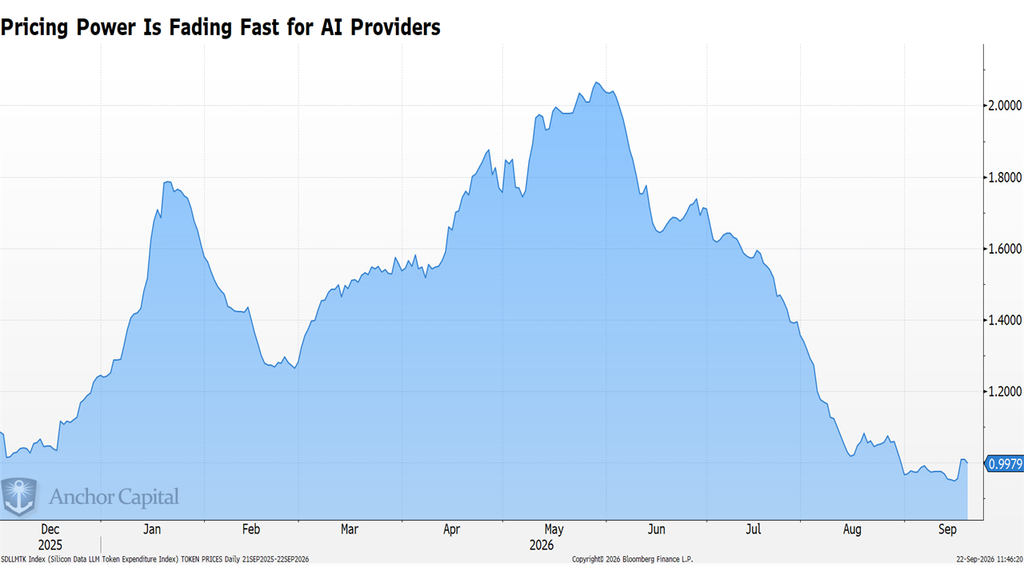
Silicon Data’s LLM Token Expenditure Index — a daily, expenditure-weighted benchmark of what the market pays per million LLM tokens — has quietly given back its entire 2026 advance. The index launched near 1.09 in December 2025, nearly doubled to roughly 2.07 by May, and has fallen in an almost uninterrupted slide since. As of early September, it’s back near 1.00; essentially unwinding a year’s worth of gains in four months.
That matters more than a single chart usually would, because the index isn’t measuring chip demand or usage volume; it’s measuring price. A falling token price means one of two things is happening, or both: buyers are shifting their usage toward cheaper, more efficient models, or providers are cutting prices to defend market share against increasingly cost-sensitive customers. Either way, it’s a pricing-power signal, and pricing power is exactly what’s supposed to fund the buildout.
That buildout is not small. AI-related capex is running at roughly $700 billion a year now and is on a path toward $1 trillion by 2027 — a buildout being financed on the assumption that token revenue keeps scaling to support it. Allianz Research has pegged the gap between AI capex growth and AI-linked sales growth at around 46% — wider than the roughly 32% divergence seen in the telecom overbuild right before the 2001 bust1. If the price side of the revenue equation keeps eroding, providers need usage volume to grow even faster just to hold revenue flat, before they can fund the next generation of chips and data centers.
The number worth watching from here isn’t any single model’s list price; it’s this index. If it keeps grinding lower, the capex math funding the current AI buildout gets considerably harder to defend.
1 https://www.allianz.com/content/dam/onemarketing/azcom/Allianz_com/economic-research/publications/specials/en/2026/march/2026_03_25_AI.pdf