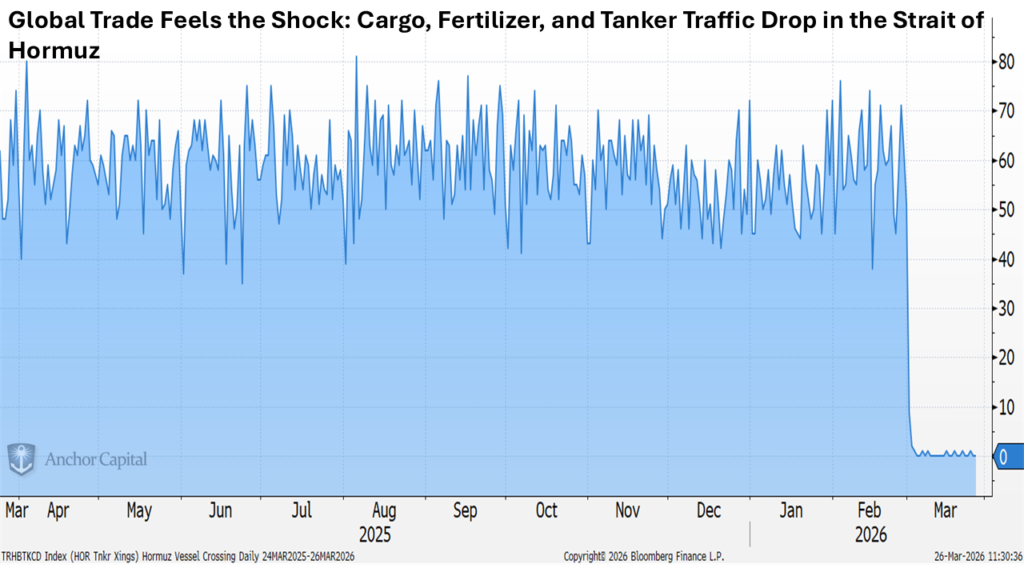
When U.S.-Iran tensions escalated into active military confrontation in late February, shipping operators didn’t wait for an official closure of the Strait of Hormuz.
They simply stopped going.
Crossings did not see a gradual decline, or a cautious pullback. They fell vertically, off a cliff.
And this isn’t just an oil story.
Traffic from commercial cargo ships, fertilizer carriers, and other broad-based trade flows all collapsed in tandem. When a chokepoint becomes a target, market logic surrenders to survival logic. No freight rate justifies the risk.
What we’re seeing is strategic geography being weaponized in real time. The Strait of Hormuz has become a tool of geopolitical signaling, and global commerce is becoming collateral damage.
The consequences ripple far beyond the energy markets. Stalled fertilizer shipments means agricultural costs rising. Cargo disruptions mean supply chains under stress.
And no visible rebound means operators aren’t betting on a quick resolution
This isn’t a pause. There’s no V-shaped recovery forming in the shipping lanes. The market has effectively priced in continued instability, and positioned accordingly.
You don’t need to formally close a waterway to fracture it. You just need to make the risk calculus impossible to justify.